SITUATION:
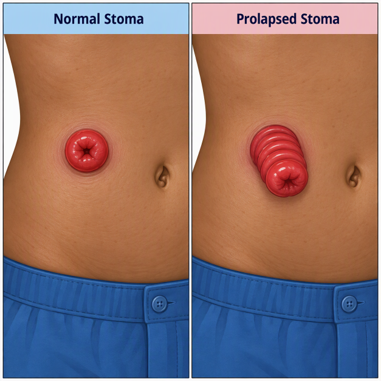
Children with an ostomy may experience a stoma prolapse, where more of the bowel protrudes out from the body than usual, causing the stoma to appear longer, larger, or more swollen than the child’s baseline. A prolapse can make pouching difficult and may cause irritation or swelling. In more serious cases, it can interfere with ostomy output or compromise blood flow to the bowel.
BACKGROUND:
Typically, a stoma protrudes approximately 1 to 2 cm above skin level at baseline. A stoma prolapse occurs when the bowel extends further out from the level of the skin causing the stoma to become longer or more prominent. A prolapse may be intermittent, returning to its usual size and protrusion level when the child rests or lies down, or persistent. Increased abdominal pressure or weakness of the abdominal wall may allow more of the bowel to protrude. Infants and young children may be more susceptible because their abdominal muscles are still developing.
Factors that may contribute to stoma prolapse include:
- Coughing, sneezing, or prolonged crying
- Straining with bowel movements or constipation
- Abdominal distension or increased abdominal pressure
- Intestinal dysmotility
- Activity or movement, particularly during the early post-operative period
ASSESSMENT:
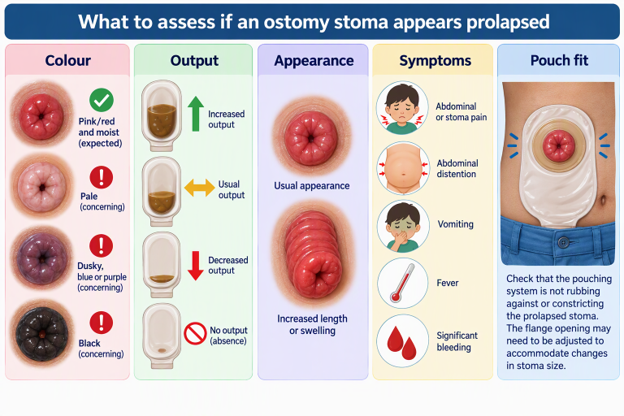
If the stoma appears prolapsed, assess the following:
- Colour and moisture: The stoma should remain pink or red and moist. A pale, dusky, blue, purple, or black stoma is concerning for compromised blood flow.
- Output: Compare the amount and type of output with the child’s baseline. A significant decrease or absence of output is concerning, especially with pain, vomiting, or abdominal distension.
- Appearance: Note the change in length, swelling, and whether the prolapse decreases when the child lies down and rests.
- Symptoms: Assess for abdominal or stoma pain, abdominal distension, vomiting, fever, or significant bleeding.
- Pouch fit: Check that the pouching system is not rubbing against or constricting the prolapsed stoma and that the flange opening accommodates changes in stoma size.
RECOMMENDATION:
Connected Care recommends the following when a stoma prolapse occurs in home and community settings:
- Position and rest
- Have the child lie flat and rest for up to 20 minutes. Reducing abdominal pressure may allow the swelling and prolapse to resolve.
- When the child is upright, provide gentle support over the pouch during coughing or sneezing, if this is comfortable and recommended by the healthcare team.
- Reduce swelling
- Apply a cool compress (ice in a bag with a towel wrapped around) over the ostomy pouch for 5 minutes at a time, with breaks, for up to 15 minutes. Do not apply ice directly to the stoma or skin.
- If specifically recommended by the child’s ostomy nurse or healthcare team, white granulated sugar may be applied directly to the swollen stoma. Sugar can draw out excess fluid and reduce swelling.
- Do not manually push the prolapsed bowel back into the body.
- Protect the stoma
- Ensure the pouching system does not rub against or constrict the prolapsed stoma. The flange opening may need to be resized as swelling or stoma length changes. Seek support if the pouch is leaking or will not maintain a seal.
- An ostomy belt, supportive pouch cover, or soft abdominal support may help contain and protect the stoma during movement. Use only if recommended and ensure it does not constrict the stoma or reduce output.
- Monitor closely and seek support
- Continue to monitor stoma colour, moisture, swelling, output, pain, abdominal symptoms, and the child’s overall condition.
- Contact the child’s ostomy nurse or healthcare team for a new prolapse, a change from baseline, difficulty pouching, recurrent prolapse, or guidance on the child-specific management plan.
- Seek urgent medical attention if:
- The stoma becomes pale, dusky, blue, purple, or black
- Ostomy output stops or significantly decreases, especially with abdominal distension, pain, or vomiting
- There is persistent or worsening abdominal or stoma pain
- There is significant or persistent bleeding
- The prolapse becomes increasingly swollen or firm, cannot be easily pouched, or does not decrease with rest