SITUATION:
This QuickHit was informed by questions from home and community care providers regarding the routine maintenance of indwelling urinary catheters.
BACKGROUND:
A urinary catheter is a thin tube that passes through the urethra and into the bladder. Children with medical complexity may rely on urinary catheters to drain urine from the bladder if they are unable to empty their bladder on their own, experience frequent leaking from their bladder, or if they develop high pressure in their bladder.
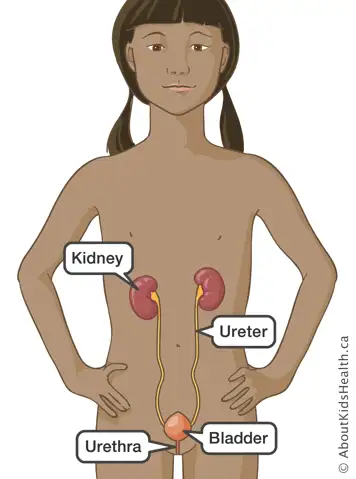
Most children in the home and community setting require intermittent catheterization (also referred to as in-and-out catheterization) which involves inserting a catheter into the bladder at specific times throughout the day to drain urine as outlined in the child’s care plan.
An indwelling urinary catheter (also called a Foley catheter) remains inside the child’s bladder to drain urine over a longer period of time (e.g. overnight). Indwelling catheters require specific care during insertion and maintenance to ensure cleanliness and prevent infection, otherwise known as a Catheter Associated Urinary Tract Infection (CAUTI).
Children in the home and community with indwelling catheters may also have catheter irrigation ordered which involves flushing the catheter with normal saline to remove blockages and allow easy drainage of urine.
ASSESSMENT:
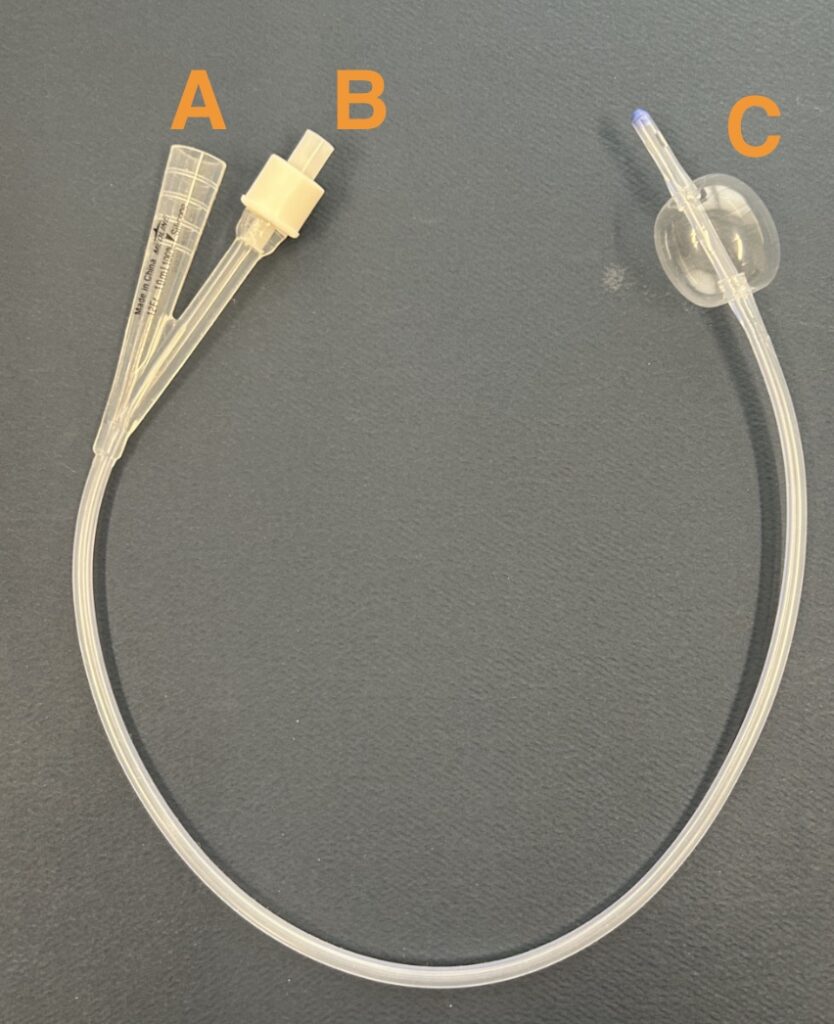
An indwelling urinary catheter has a balloon that is inflated with sterile water which holds it in place within the bladder. The parts of an indwelling urinary catheter are shown below:
- Balloon: Keeps the catheter inside the bladder once inflated
- Drainage Port: Where urine drains out from (into a collection bag or diaper) or where a syringe is attached to irrigate the catheter if ordered
- Balloon Inflation Port: Location where syringe with appropriate volume of sterile water is attached to inflate balloon
Children with an indwelling catheter may be at risk for developing a CAUTI. Symptoms of a CAUTI may include but are not limited to:
- Fever (a temperature of 38°C or higher)
- Changes in urine appearance (e.g. colour, clarity, presence of sediment) or smell
- Unexplained fussiness in a baby or young child
- Vomiting or abdominal (belly) pain
- Back pain (specifically on either side of the back, sometimes called “flank” pain)
- Blood in the urine (may appear as blood clots)
RECOMMENDATION:
When caring for a child with an indwelling urinary catheter, Connected Care recommends the following:
- Ensure there is a medical order for indwelling catheter placement and catheter irrigation (if applicable).
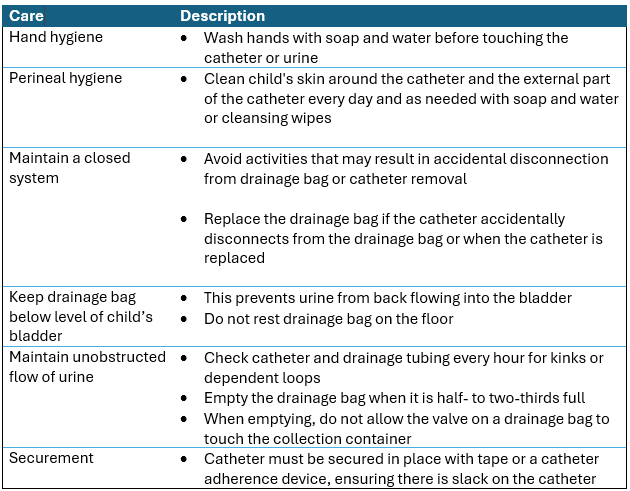
- To prevent a CAUTI while maintaining an indwelling urinary catheter, follow the care below:
- Partner with the child’s family caregiver and seek medical attention if:
- The child develops any symptoms of a urinary tract infection.
- If the indwelling catheter is accidentally removed and you do not know how to insert it or have been instructed not to reinsert it.
- If catheter irrigation is ordered and you cannot unblock the catheter using irrigation.
- Remove the indwelling catheter as ordered by the child’s medical team if you know how. Leaving an indwelling catheter in the bladder longer than needed increases the risk of a CAUTI
For more information on urinary catheterization visit the following AboutKidsHealth articles: Indwelling catheter care and irrigation, clean intermittent catheterization for male anatomy, clean intermittent catheterization for female anatomy and Urinary Tract Infection .