SITUATION:
This Quick Hit was informed by Connected Care Live consults from home and community care providers about changing balloon Gastrostomy tubes (G tubes).
BACKGROUND:
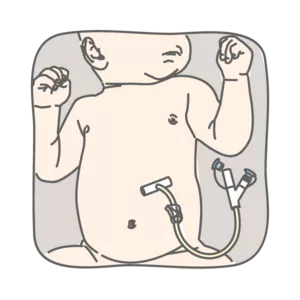
Many children with medical complexity rely on feeding tubes to support nutrition, hydration and/or medication administration. There are different types of feeding tubes, placed in specific part(s) of the gaMany children with medical complexity rely on G tubes to support nutrition and/or medication administration. A balloon G tube is a feeding tube with a small balloon at the end that sits in the stomach to help keep it in place. The balloon is filled with sterile or distilled water.
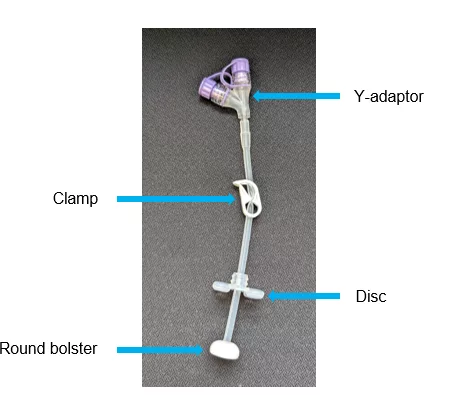
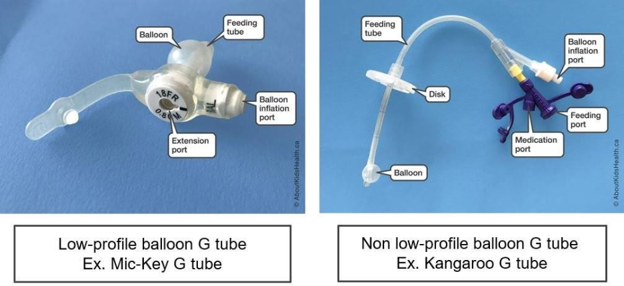
There are two types of balloon G tubes: low-profile and non low-profile. A low-profile balloon G tube sits close to the skin, and a non low-profile balloon G tube extends further out of the abdomen and has a disk to stabilize the tube.
ASSESSMENT:
How to assess whether the balloon G tube needs to be changed?
- It is recommended that balloon G tubes are changed every six to eight months, or sooner if needed. This helps to prevent the balloon from leaking or breaking, which can cause the G tube to accidentally fall out.
- You should check the balloon volume on a weekly basis to help you know whether the balloon may be leaking or broken.
- If there is a difference of more than 0.5mL of water from what was previously put in the balloon, the balloon may be leaking or broken. You may temporarily tape down to tube to the child’s skin until the balloon G tube can be replaced with a new one.
What are the risks associated with changing a balloon G tube?
- Perforation: If the new tube is not inserted into the existing tract, it can create a new tract or space inside the body.
- Infection: replacing the tube can irritate the stoma (the hole in the abdomen where the tube is placed) and introduce bacteria. To help prevent infection, clean the stoma before inserting the new tube.
- Increased granulation tissue: tube changes may irritate the stoma, leading to excess tissue growth.
RECOMMENDATION:
Connected Care recommends the following when changing a balloon G tube:
- Partner with the child’s family caregiver to track when routine G tube changes are due and who will perform them. Note, balloon GJ and G/GJ tubes cannot be changed at home and must be changed in hospital.
- Watch the AboutKidsHealth video and read the article for step-by-step instructions on changing a balloon G tube and checking tube placement. Main points to consider include:
- Ensure you are inserting a new balloon G-tube that is the correct size for the child. The correct size (e.g. 12 French) will be outlined in the child’s care plan.
- Before inflating the balloon, make sure the new tube is in the child’s stomach. This is done by checking the pH of the fluid drawn from the tube.
- Once the placement is confirmed, inflate the balloon with the required amount of sterile or distilled water.
- Following a tube change, monitor:
- Stoma site: assess for redness, discharge, rash or granulation tissue
- Child’s condition: monitor for signs of feeding intolerance, a hard bloated stomach, severe pain in the stomach, vomiting/diarrhea, coughing/ gagging, sudden high fever, breathing difficulty, problems with feeds and liquids getting into the lungs (aspiration).If you notice any of these signs, stop using the G tube and seek medical help to check placement.
- If you are unable to insert the new balloon G tube into the stoma, use the
For more information about balloon G tubes, please visit the following articles: G tubes: Balloon G tubes and G/GJ tubes: Checking the balloon on a feeding tube