SITUATION:
This QuickHit was informed by recent feedback from families indicating that nasogastric (NG) tubes used in homecare may come with or without guidewires, creating challenges with insertion in home and community settings.
BACKGROUND:
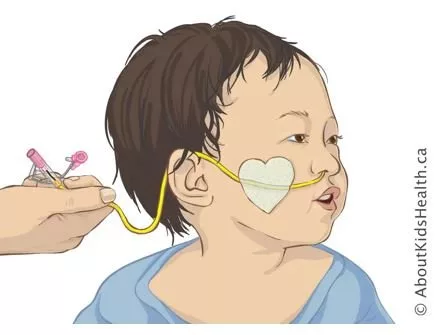
Many children with medical complexity rely on enteral feeding tubes to support nutrition, hydration, and medication administration. NG tubes are a commonly used enteral feeding tube in home and community settings. An NG tube is a long, thin, hollow tube which is passed through a nostril of the nose into the throat and down into the stomach.

NG tubes may be supplied with or without a guidewire (also called a stylet). For children, NG tubes with a guidewire are preferred, as the guidewire provides temporary rigidity which supports safer and easier insertion. The guidewire is removed once placement in the stomach is confirmed. In recent months, inconsistent access to NG tubes with guidewires in home and community settings has made insertion more difficult for some family caregivers and home and community care providers.
ASSESSMENT:
NG tubes used in home and community settings are typically made of a flexible polyurethane material and are replaced every four weeks. The child’s healthcare team develops an individualized plan for NG tube insertion and replacement (e.g., clinic-based or at home).
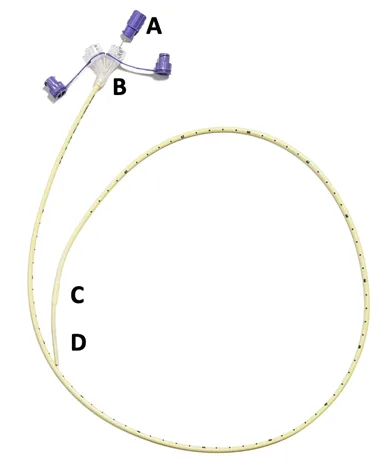
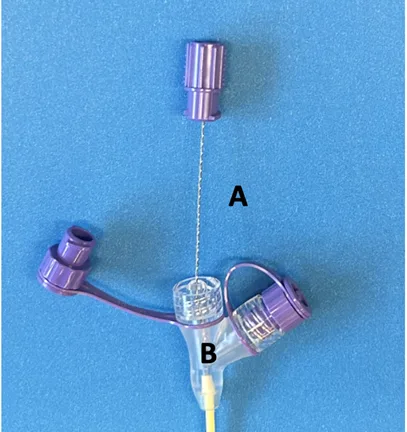
An NG tube consists of the following components:
- Guidewire (A): A thin metal wire threaded inside the full length of the NG tube during insertion to provide rigidity and support with ease of insertion.
- Main and side ports with ENFit connectors (B): The location where syringes or feeding sets attach to the NG tube.
- Exit port (C): The opening at the distal end of the tube where nutrition, fluids, or medications enter the stomach.
- Weighted tip (D): The end of the tube (past the exit port) that is heavier than the rest of the tube for the purpose of anchoring the tube inside the child’s stomach. Not all children will have an NG tube with a weighted tip.
RECOMMENDATION:
Connected Care recommends the following best practices when using NG tubes with guidewires:
- Confirm the type, size, indication, and replacement frequency of the NG tube and additional safety considerations in the child’s care plan.
- Order NG tubes with guidewires whenever possible, as they improve ease and safety of insertion. When ordering/purchasing supplies, carefully review the product description to confirm that the NG tube includes a guidewire.
- Do not attempt to insert a guidewire into an NG tube that is not designed for use with a guidewire.
- Before insertion, ensure the guidewire moves freely and can be easily removed. Secure the guidewire to the main port prior to insertion.
- Review and follow the appropriate steps for NG tube insertion and confirmation of placement.
- After insertion and confirmation of placement, activate the tube’s internal lubricant and remove the guidewire before using the NG tube.
- Store the guidewire in its original packaging for future use. If the tube is accidentally dislodged before the next scheduled change, the NG tube may be reused if it is not damaged and the guidewire may be reinserted into the tube to support with insertion.
For additional information, visit AboutKidsHealth resources on: