SITUATION:
This QuickHit was informed by Just In Time Training with a home and community care provider who was unsure about what is included in an emergency tracheostomy kit.
BACKGROUND:
Children with tracheostomy tubes require an emergency tracheostomy kit. Emergency equipment must remain with the child and be easily accessible for both routine and emergency use at all times.
Home and community care providers should ensure that the emergency tracheostomy kit has the appropriate contents at the beginning of each shift and before travelling.
ASSESSMENT:
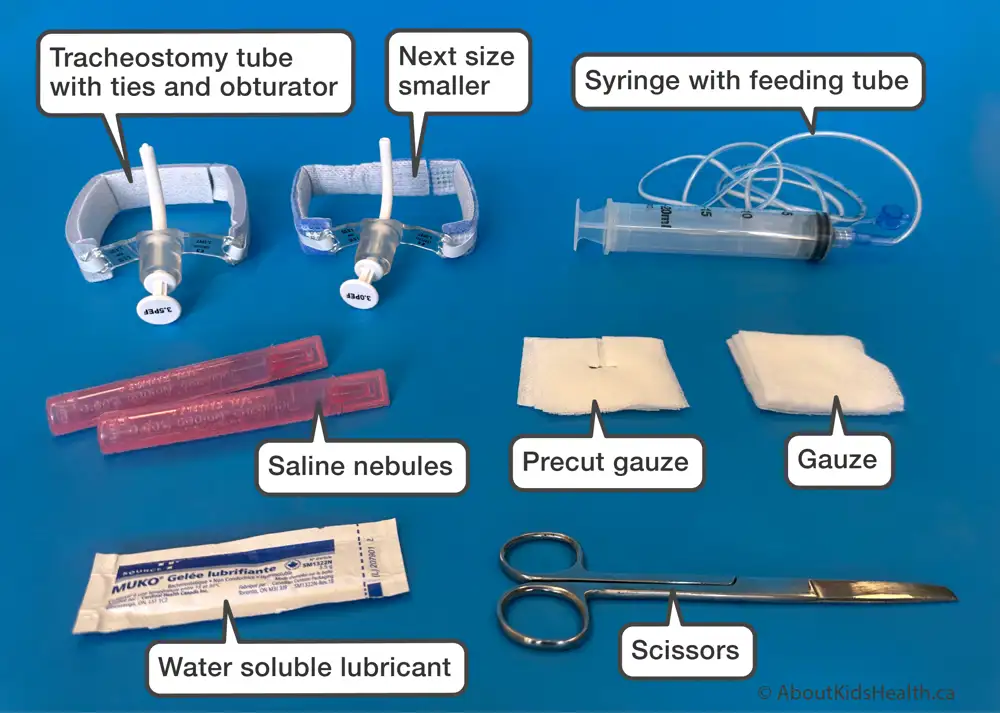
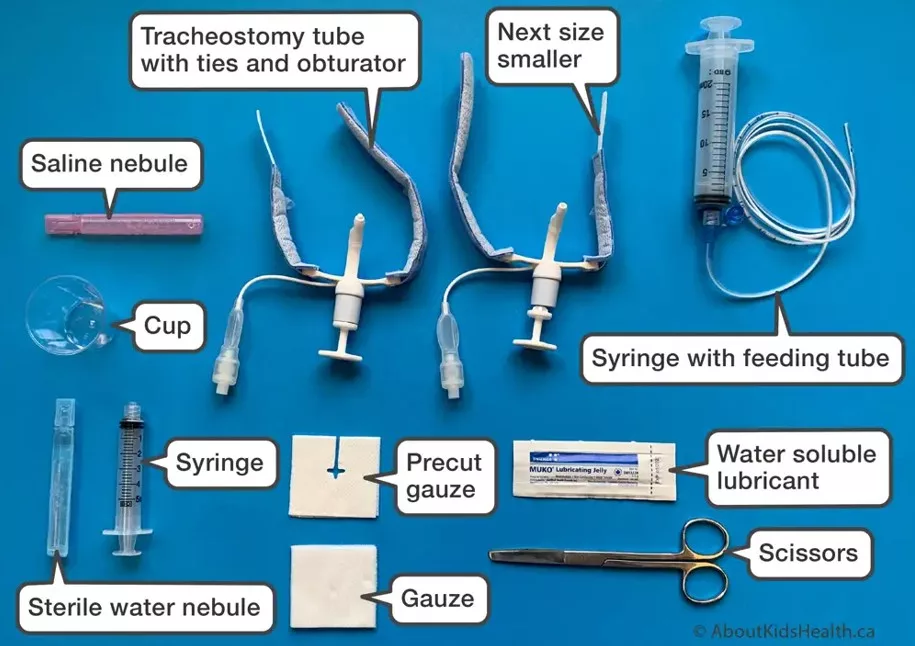
The emergency tracheostomy kit should contain the following equipment:
- Spare tracheostomy tube (same size) with obturator and ties assembled
- Spare tracheostomy tube (one size smaller) with obturator and ties assembled
- A 2.5 mm inner diameter tracheostomy tube is the smallest size available. If the child has a 2.5 mm tracheostomy tube, their health-care team will inform you how to manage emergencies.
- Normal saline (e.g., nebules)
- Water soluble lubricant
- Blunt-ended scissors
- Clean tracheostomy dressing or pre-cut gauze if needed
- Gauze for cleaning
- Manual suction set up (20mL syringe with feeding tube attached that is the same size as suction catheter used for child’s tracheostomy tube)
- Ensure you have a feeding tube that is one size down if the smaller size tracheostomy tube is being used
- A Leur lock syringe (for cuffed tracheostomy tubes only)
- Sterile water and cup (if child has a water filled cuff)
RECOMMENDATION:
Connected Care recommends the following related to tracheostomy emergency kits:
- Ensure that the emergency tracheostomy kit is with the child and easily accessible at all times.
- Check the contents of the emergency tracheostomy kit at the beginning of each shift and before travelling. If children have more than one emergency tracheostomy kit, ensure that all are checked.
- Confirm that tracheostomy ties are in good condition. The tracheostomy tubes should be checked to ensure that the obturator slides in and out with ease, there are no cracks or discolouration, the labels on the flange are legible, and cuffs are checked if applicable.
- Check the cuffs by inflating them with 5mL of water (for water filled cuffs) or air (for air filled cuffs) to assess for leaks or breakage. Then deflate the cuff.
- Ensure that all supplies in the kit are not expired.
- Ensure that only necessary supplies are placed in the kit. Avoid overfilling with extra supplies as this may delay finding the item(s) you need in an emergency situation.
- Ensure you have suction catheters that fit both the same size tracheostomy tube and the tracheostomy tube that is one size down.
- Keep both of the spare tracheostomy tubes separate from each other in clear, labelled bags (e.g., using bright coloured labels).
More information
To learn more about pediatric tracheostomy care, visit the Tracheostomy care for children: For family caregivers and homecare providers.
Sections of this manual related to the emergency tracheostomy kit include The emergency tracheostomy kit, Changing a tracheostomy tube, One-person tracheostomy tube change and Managing tracheostomy tube emergencies.