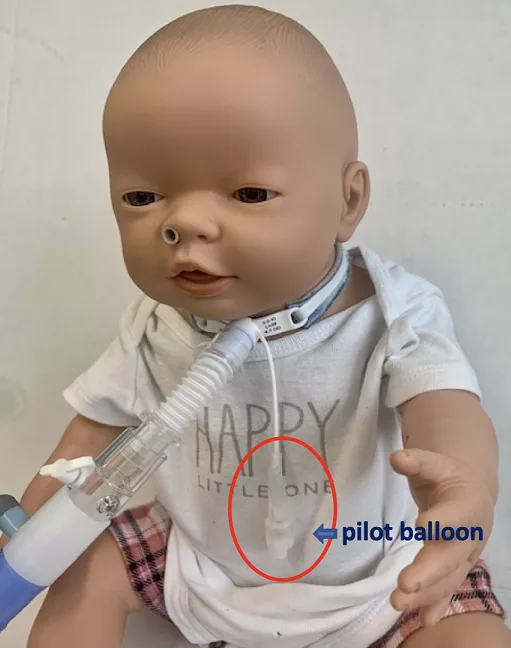
SITUATION:
This Quick Hit was informed by a recent discharge of a child with a critical airway that required additional education for home and community care on the use of a stoma mask for manual ventilation in the event of an emergency.
BACKGROUND:
Some children with tracheostomies can breathe and be ventilated through their mouth and nose as well as through their tracheostomy stomas. A select group of children with tracheostomies have ‘critical airways’ and cannot breathe nor be ventilated via their mouth and nose due to anatomical or surgical reasons.
Children with critical airways rely entirely on their tracheostomy tube and are at higher risk of needing urgent interventions such as emergency tracheostomy tube changes and the use of a stoma mask.
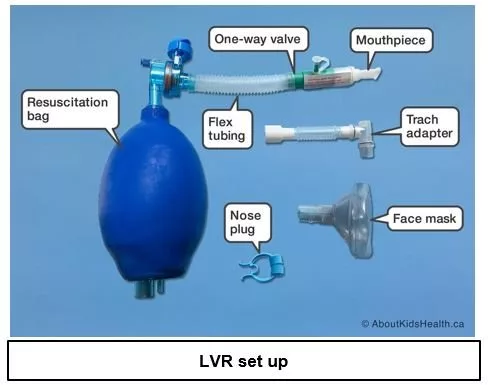
A stoma mask is a neonatal-sized face mask that is used to provide manual ventilation via the stoma in the event of a full decannulation where the tracheostomy tube is unable to be reinserted. The stoma mask creates a seal required to deliver manually ventilated breaths using a manual resuscitation bag.
ASSESSMENT:
Ask the child’s family caregiver and their point-of-care team if the child has been assessed to have a critical airway. Review the child’s chart and ensure there are nursing orders/care plan to flag the critical airway. Confirm that all family caregivers and home and community care providers have up-to-date child CPR certification.
Assess for readiness at all times to provide breathing support when:
- A tracheostomy tube of the same size or smaller cannot be inserted.
- The child cannot adequately and comfortably breathe through an open stoma.
- The child is in respiratory distress, requires mechanical ventilation, or is deteriorating (e.g. trouble breathing, altered respiratory rate, decreased oxygen saturations).
RECOMMENDATION:
Connected Care recommends:
- Understand the child’s indications for a tracheostomy tube and if they have a critical airway.
- Be prepared to manage emergency tracheostomy tube changes and stoma ventilation.
- Partner with family caregivers to discuss the plan for everyday safety and emergencies.
At the beginning of each shift and when travelling with the child, always perform a safety check. See this Connected Care QuickHit What is included in an emergency tracheostomy kit AND check that a stoma mask and a manual resuscitation bag are also available. Familiarize yourself with the emergency tracheostomy kit. Know where it is kept, and double check that the contents of the kit are clean and have been restocked. Keep this kit within arm’s reach in case of an emergency.
Connected Care encourages home and community care providers to routinely participate in scheduled tracheostomy changes to promote competency in tracheostomy tube changes. See this Connected Care QuickHit How to be prepared to perform an emergency trach change.
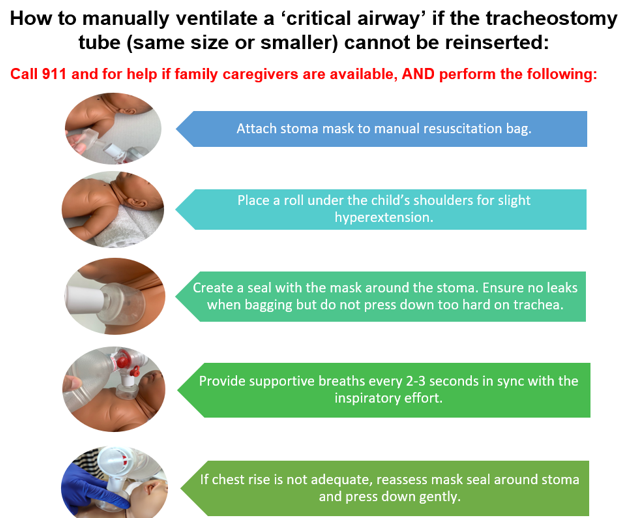
BEGIN CPR AT ANY TIME IF A CHILD BECOMES UNRESPONSIVE
To access a Paediatric Tracheostomy Care Safety Checklist developed by Connected Care, register to use Connected Care Live and search or consult us to locate them!