SITUATION:
This Quick Hit was informed by education requests from home and community care providers on best practices for performing Clean Intermittent Catheterization (CIC).
BACKGROUND:
Children with medical complexity may experience urinary retention that poses a risk for kidney infections or damage from reflux of urine back into ureters and kidneys.
CIC is the technique for inserting a catheter into the urethra to drain urine from a child’s bladder when they are unable to empty their bladder on their own, experiences leaking from their bladder, or for those who develop high pressure in their bladder.
Urinary catheterization is often scheduled as an activity of living, sometimes required several times per day.
ASSESSMENT:
When caring for a child who requires CIC, follow the child’s orders for the catheter size, type and frequency of catheterization. They should NOT skip any scheduled catheterizations. While there is variability depending on the child’s unique needs, it is recommended not to go longer than eight hours without doing CIC at night.
Catheter size (French) will depend on the child’s size and unique anatomy, but generally the following guides the recommended catheter size based on a child’s age and weight:
| Child Weight in Kilograms | Urinary Catheter Size |
|---|---|
| Preterm infants and infants less than 3 kg | 3.5 – 5 French using a straight catheter |
| Small infant (3 – 5 kg) | 6 French |
| Small infant (6 – 7 kg) | 6 – 8 French |
| Infant (8 – 9 kg) | 6 – 8 French |
| Toddler (10 – 11 kg) | 8 – 10 French |
| Small child (12 – 14 kg) | 10 French |
| Child (15 – 18 kg) | 10 – 12 French |
| Child (19 – 23 kg) | 10 – 12 French |
| Large Child (24 – 29 kg) | 12 French |
| Adult (30 – 36 kg) | 12 French |
The smaller the French size, the thinner the catheter. Consider factors which could impact safety and comfort with urinary catheterization, such as history of hematuria, ureter discharge, inflammation of the genito-urinary tract, trauma to pelvis/abdomen, recent surgery of the lower urinary tract, or previous difficult catheterizations. Discuss these with the child’s family caregiver or point-of-care clinical team for guidance.
The child’s order may state to use a coude catheter. A coude catheter has a small hook at the end to facilitate catheter entry for children with unique anatomy. If a child is ordered CICs with a coude catheter, the tip should point upward (towards the sky) when inserting into the urethra.
RECOMMENDATION:
Connected Care recommends the following:
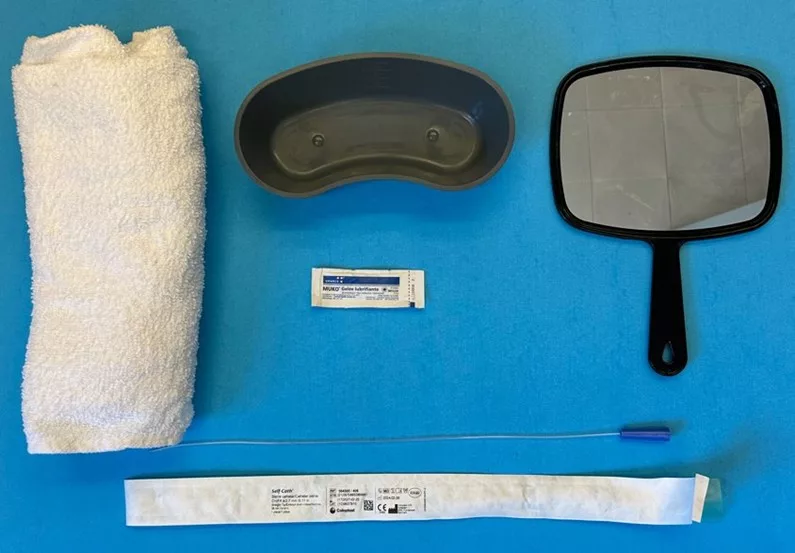
- Prior to performing a CIC, familiarize yourself with the procedure, don the recommended personal protective equipment for routine practices, and prepare the following supplies:
- Urinary catheter
- Lubricant jelly (e.g., Muko or K-Y jelly). Do not use Vaseline or mineral oil.
- Soap and water
- Wash cloth or wipes
- Clean, dry towel
- Urine collection container, if desired (or catheter can drain into the toilet)
- Hand mirror if needed.
See this About Kids Health articles for step by step Instructions on how to preform CIC:
- Clean intermittent catheterization (CIC): Instructions for children with male anatomy
- Clean intermittent catheterization (CIC): Instructions for children with female anatomy
- Tips for Preforming the CIC procedure:
- Wash hands prior to preforming CIC. In the home and community setting, urinary catheterization is typically completed using a clean technique rather than a sterile technique.
- Make sure the child is in a comfortable position.
- Older children may be able to perform CICs on themselves. If so, they can sit on the toilet or in a chair across from the toilet. Also, they can do catheterization lying down or standing with one foot on a chair or the toilet rim.
- During catheter insertion, there may be some resistance at the sphincter, which acts like a door to the bladder. Encourage the child to breathe slowly and relax their muscles so that the catheter can pass easily.
- If resistance is still met, do not force catheter advancement as this may lead to trauma or curling of the catheter. Stop and notify the child’s family/health-care team
- Assess the colour, smell, and clarity of the urine for signs of infection (e.g., cloudy, foul smelling urine with or without fever) and seek medical attention if appropriate. See this About Kids Health article for more information about Urinary Tract Infection.
- You may occasionally see small blood drops around the catheter during the procedure. Ensure to lubricate the catheter before use. Occasional drops of blood are typically not cause for concern.
- Managing supplies:
- If the catheter falls on the floor or is otherwise visibly soiled before performing a CIC, discard it and use another one.
- The standard of practice is to discard catheters after one use. Sterilizing and re-using catheters for CIC is not recommended. It can significantly increase a child’s risk of urinary tract infection.